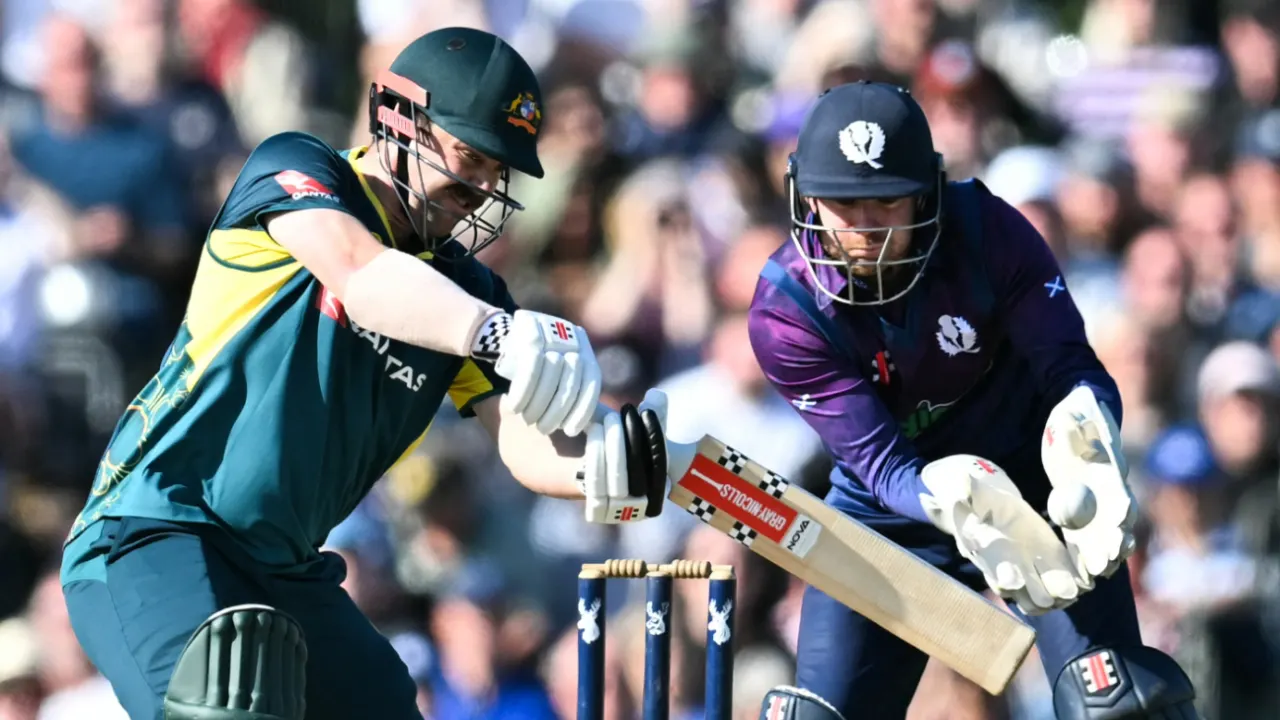

Australia raced to a seven-wicket victory with more than 10 overs remaining in the first T20I in Edinburgh after the bowlers had pulled back a bright start from Scotland. Travis Head produced a brutal display of hitting, scoring the most individual runs in a powerplay and hitting a record-equaling fifty.
Even though they lost wickets in an effort to maintain a high early run rate, the home team, led by George Munsey, started the game well and with good intentions. They were in a promising position. Notwithstanding, from 101 for 3 in the twelfth over they lost 6 for 44 with the progressions of speed from Australia’s quicks demonstrating powerful on a marginally two-paced surface close by two wickets from Adam Zampa.
Following Jake Fraser-McGurk’s duck in his T20I debut, an extraordinary display of powerplay hitting by Head and Mitchell Marsh dispelled any notion that 154 might be competitive. Australia finished with the second-highest powerplay total in T20Is, with 113 for 1, of which Head had 73, surpassing Paul Stirling’s 67 runs against West Indies in 2020. At one point, 14 deliveries were boundaries.
Head’s assault (and some Marsh) It was easy to forget that Fraser-McGurk was making his T20I debut given how much he has been talked about this year. He faced up to the somewhat unexpected sight of Brandon McMullen’s medium pace with the new ball, but he was unable to make a difference in his first innings. He misjudged his third delivery and went into midwicket, where Charlie Cassell made an excellent catch.
However, any contemplations of a wobble for Australia disappeared in a parade of limits. Head, who was player of the competition in the MLC in July, took three fours of Brad Wheal’s most memorable over and allowing McMullen a second over didn’t pay off as it cost 20. However, Jack Jarvis was spared the real devastation in the fifth round when Marsh took him down for 30 with three sixes. With multiple deliveries going into the trees, Scotland’s bowlers did not respond.
Head hit a 17-ball fifty off the first ball of the sixth over, matching Marcus Stoinis’ record for Australia’s fastest T20I fifty in a run of 14 fours or sixes in a row.
Munsey’s powerplay promise Australia were under some pressure with the ball in the powerplay thanks to repeated whip-pulls over the leg side from Scotland opener George Munsey. McMullen also contributed. Munsey was the first to pepper the boundary.
Munsey hit six off consecutive deliveries from Riley Meredith in the fifth over, his first T20I since 2021. He then hit another boundary, and 18 runs were scored. Munsey raised Scotland’s fifty in the following over, however at that point tumbled to a fantastic catch by Josh Inglis who plunged to one side to gather a thick external edge.
McMullen was taken at deep cover shortly after the fielding restrictions ended, further hampering Scotland’s progress. There were indications of commander Richie Berrington beginning to get settled yet his excusal, captured at long-off against Zampa, demonstrated a defining moment in the innings. From that point Scotland attempted to recover any energy. Continuous overs from Stoinis and Cameron Green went for only four each as the consolidated four overs from the two allrounders cost just 22 runs.
Meredith, Xavier Bartlett and Sean Abbott finished off the innings firmly with just a support of attractive sixes by Jack Jarvis and Imprint Watt offering a lot of accordingly.
Watt’s long ball Despite Head receiving the most attention in the chase, Marsh scored 39 off 11 balls before being bowled by Watt’s first delivery. The left-arm spinner was held back due to fielding restrictions when he might have been used earlier.
By that stage the outcome was unavoidable, yet there were several fascinating minutes as Australia knocked off the excess runs with Watt’s long ball – conveyed from well back from the bowling wrinkle – two times seeing hitters pull away exceptionally late. The first time this happened was when Inglis made the opening delivery, and the ball hit the leg bail. When Stoinis was on strike, it happened again. The Law’s wording (20.4.2.5) says that the umpire was right both times, but it could be a topic of conversation in the next two games, when Scotland hopes to be more competitive.